
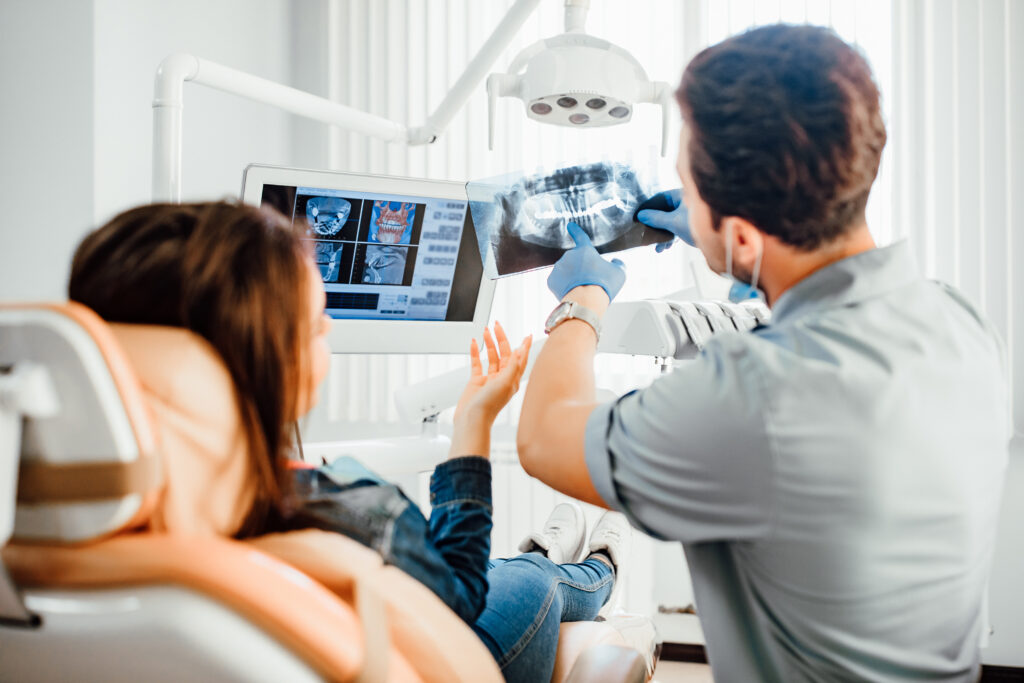
Have you ever wondered why your oral surgeon takes X-rays of your teeth and jaw, even though you’re getting an examination right there in person? While they may seem unnecessary, dental X-rays actually serve a very important purpose. Here’s a closer look at why your oral surgeon still relies on radiographs to help make your dental treatment better, and what exactly he or she is looking for when they read them!
Why Are X-Rays Important?
When you visit the dentist for your preventive exam and cleaning appointments, they may inform you that you need to have X-rays taken. These images may be necessary once a year to monitor the health of your teeth and jawbones. Because they reveal what is below the gumline and deep into the structures of the teeth, they can often be more effective than a visual examination at detecting problems like bone deterioration, cysts, abscesses, and even undeveloped or impacted teeth.
There are several different types of X-rays that may be taken at your dental or surgical exam. Most often, patients only require bitewing or periapical images. Bitewings are ideal for detecting early signs of tooth decay between the back teeth or bicuspids (the teeth that are in front of the molars), while periapical typically focus on just one or two teeth.
Panoramic X-Rays
In recent years, dentists and surgeons have begun using panoramic X-rays to get a full picture of a patient’s jaw in one shot. These two-dimensional images capture the entire mouth as one, allowing your dentist to better plan treatments like dental implants, dentures, braces, and extractions. They are also helpful when looking for oral health problems such as advanced stages of periodontal (gum) disease, cysts, tumors, oral cancer, TMJ disorders, impacted wisdom teeth, and sinusitis.
Cone Beam Computed Tomography (CBCT) Scans
CBCT scans create three-dimensional images of soft tissues, nerve paths, and other dental structures within the jawbone in a single scan. Although they do carry higher amounts of radiation, the cone shaped beam is more precise, meaning radiation is less likely to affect other areas of the body. CBCT scans are ideal for planning dental implant surgery, impacted tooth, jaw, sinus, and nasal cavities, to observe jaw tumors, and in reconstruction treatments. The cone beam scanner rotates around the patient while they remain still, and the results are a much higher quality image than traditional X-rays.
Are X-Rays Safe?
Often, patients are concerned about the safety of dental X-rays, because they do produce radiation that is permanently absorbed by the body. However, although cumulative, this type of radiation is typically harmless, and in most cases the benefits far outweigh the risks. To reduce the need for more detailed X-rays that carry higher amounts of radiation, be sure to maintain an excellent oral hygiene routine which includes brushing twice a day, flossing daily, and visiting your dentist every six months for your regular, preventive dental exam and cleaning appointments.
Remember, while it is still vitally important that your dentist examines your mouth in person every six months, dental X-rays can be an extremely useful tool for helping diagnose a variety of oral health conditions that may not be visible to the eyes alone. They can also help with the planning of more involved oral health procedures including dental implants, wisdom tooth extractions, and orthodontic treatments when visiting an oral surgeon.
About Our Practice
At Conestoga Oral Surgery, we are proud to use the latest technology to capture highly detailed images of the mouth and jaw. These help us cultivate a better understanding of the condition of your oral health but also help plan your treatment more effectively. If your surgeon has requested X-rays of any kind for your upcoming treatment, rest assured that these images are safe and will be used to ensure you get the best surgical outcome possible. To schedule a consultation with us, visit our website or call 717-219-4460.