
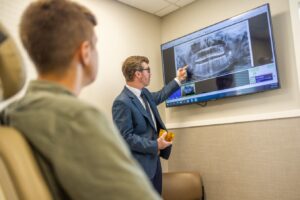
Choosing the right dental care provider is not always easy or straightforward. Most people are familiar with their general dentist. They are the providers patients see for routine exams, fillings, crowns, and oral hygiene maintenance. However, when a dentist refers a patient to an oral surgeon, a common question arises: “Why can’t my dentist just do this?” The answer lies in specialized education, training, surgical expertise, and the scope of care.
Training and Education
While both professionals begin with undergraduate studies and then attend dental school to obtain either a Doctor of Dental Surgery (DDS) or a Doctor of Dental Medicine (DMD) degree, their career paths differ after earning this degree. A general dentist may start practicing right away, focusing on preventive care, diagnosis, and treatment of common dental problems.
Oral and maxillofacial surgeons, on the other hand, complete an additional 4 to 6 years of hospital-based residency and anesthesia training, which focuses on complex procedures involving the mouth, teeth, jaws, and face. Many oral surgeons, including a few surgeons of our team, earn a medical degree (MD) during their residency training, completing medical school alongside their surgical education. This dual degree provides them with comprehensive medical and surgical knowledge that goes beyond the scope of general dentistry.
Roles in Your Oral Health
General dentists and oral surgeons work collaboratively to support a patient’s oral health. Your general dentist serves as your “primary care provider” for your oral health, performing routine checkups, cleanings, fillings, and other common treatments. Often, a patient’s general dentist is the first to diagnose issues such as impacted wisdom teeth, missing teeth, bone loss, or teeth that cannot be safely removed in a traditional dental setting.
While some general dentists can perform straightforward extractions or place simple implants, more complex procedures often require the expertise of an oral surgeon. Oral surgeons are specially trained to handle advanced surgical cases, including:
- Impacted wisdom teeth
- Dental implants and full mouth rehabilitation
- Bone grafting or reshaping
- Facial trauma
- Patients with complex medical conditions
- Procedures or patients requiring IV sedation or general anesthesia
How to Choose Which Is Right for You
Both oral surgeons and general dentists are highly trained professionals. For routine preventive and restorative care, a general dentist is usually the appropriate provider. However, when treatment becomes more surgically complex, patients may benefit from the advanced expertise of an oral and maxillofacial surgeon. If your dentist recommends seeing an oral surgeon, it is not because they are unable to help you; it means they are prioritizing your safety, comfort, and long-term outcomes by involving a specialist.
Meet the Practice
At Conestoga Oral Surgery, our team of seven board-certified oral and maxillofacial surgeons brings decades of combined surgical experience to patients throughout Central Pennsylvania. With three convenient offices in Lancaster, Hershey, and Lititz, our practice works closely with local dentists, physicians, and other healthcare professionals to provide specialized care for your whole family. To learn more about our practice or to request a consultation, get in touch with us at 717-219-4460